
Overview of this Life Science Course for Grade 5
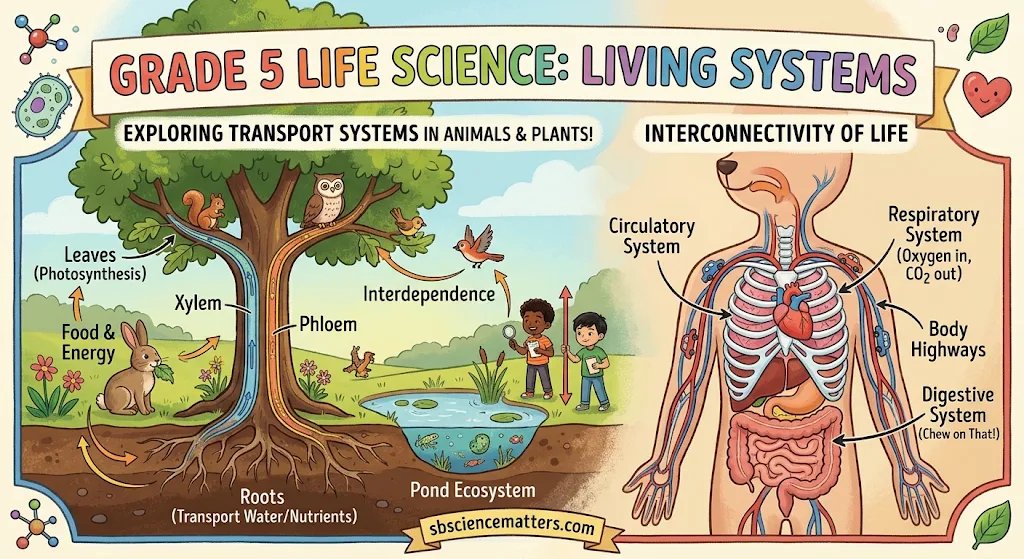
When kids reach fifth grade, science starts moving from looking at the big picture down to exploring how things actually work inside living bodies. This free 5th grade Life Science course curriculum teaches Living Systems and focuses heavily on transport systems in both animals and plants.
The core idea woven throughout the entire unit is simple: structure and function are related. It connects these concepts through 16 lessons about living systems. In this life science course from Science Matters, instead of learning somewhere by memorizing pieces of information, students learn how the architecture of plants and organs help them function and how their elements function together to keep them healthy. You may also want to see their free Life Science Course for 4th Grade and Mr. Q’s Free Life Science Course with 9 Units & 36 Lessons, Grades 3-6
What Students Discover in This Life Science Course Unit
- The Hierarchy of Life: Students learn that living things are organized from microscopic cells to tissues, organs, organ systems, and finally the whole organism.
- Animal Transport Systems: The course dives into four major human (and animal) systems responsible for moving nutrients and removing waste: respiratory, circulatory, digestive, and excretory.
- Plant Transport: Students look at how roots, stems (xylem and phloem), and leaves work together to move water and nutrients throughout a plant.
- The Photosynthesis & Respiration Cycle: The unit wraps up by showing how plants make food using sunlight, water, and carbon dioxide, and how plants and animals use cellular respiration in a continuous, beautiful cycle.
Life Science Course Lesson Plan
All lessons and instructional materials can be downloaded directly. You can grab the entire curriculum bundle or check out the individual lessons below.
- Download Complete Grade 5 Life Science Lessons (Zip file 81 MB) – Includes the complete collection of downloadable PDF resources, student activity sheets, and teacher guides for the entire living systems unit.
- Introduction and Conceptual Flow Narrative, which explains the unit’s goals and how the lessons connect.
- Conceptual Flow PDF, which maps relationships among the major ideas.
| Lesson | What students learn and do | PDF Lesson link |
|---|---|---|
| 1. Hierarchy | Students explore how smaller parts make up larger living structures: cells form tissues, tissues form organs, and organs work together in systems. A “Lego-man” analogy helps make this organization easier to picture. | Download PDF |
| 2. Structure–Function | Using familiar objects such as sports balls, students investigate how something’s shape, materials, and parts help it perform a particular job. They then connect this idea to living organisms. | Download PDF |
| 3. Just Breathe | Drawings and puzzles introduce the respiratory system and its role in exchanging oxygen and carbon dioxide. Students begin with their existing ideas and compare them with what they learn. | Download PDF |
| 4. Under Pressure | Students build a lung model using bottles and balloons to explore inhalation, exhalation, and the role of pressure changes in moving air. | Download PDF |
| 5. You Gotta Have Heart | Diagrams and discussion introduce the heart’s parts and how its structure supports pumping blood through the circulatory system. | Download PDF |
| 6. Heart to Heart | Learning stations extend students’ study of the heart. The lesson includes a heart dissection, allowing students to compare earlier drawings and diagrams with an actual organ. | Download PDF |
| 7. The Body’s Highways | Students investigate arteries, veins, and capillaries through a highway analogy and a simulation that follows blood from the heart, around the body, and back again. | Download 2-file ZIP |
| 8. Let’s Get Connected | Students bring the respiratory and circulatory systems together, tracing how blood travels between the heart, lungs, and body as it carries oxygen and carbon dioxide. | Download PDF |
| 9. Digestion: Chew on That! | A cracker-chewing investigation introduces mechanical and chemical digestion. Students discover that digestion begins in the mouth, not just in the stomach. | Download PDF |
| 10. Digestive System Simulation | Students build a digestive-system model with bags, tubing, nylon material, and cups, then use bananas and crackers to simulate food moving through it. | Download PDF |
| 11. Excretory System | Students model the system that removes liquid waste and excess water from the body, learning the roles of the kidneys, ureters, bladder, and urethra. | Download PDF |
| 12. Plant Macro Transport | The focus shifts to plants. Students revisit roots and stems as transport structures, with particular attention to different root types. | Download 2-file ZIP |
| 13. Celery Lab | Students place a split celery stalk in colored water, make predictions, and record changes. The investigation introduces transport tissues and helps students discuss the different roles of xylem and phloem. | Download PDF |
| 14. Leave It to the Leaves | Leaf rubbings reveal visible structures such as veins and stalks. Discussion and visual materials introduce stomata and chloroplasts, connecting leaf structure with transport and photosynthesis. | Download 2-file ZIP |
| 15. Photosynthesis Play | Students compare how plants and animals obtain food, then perform a readers’ theater activity showing how plants use light, water, and carbon dioxide to produce sugar and oxygen. | Download PDF |
| 16. Photosynthesis–Cellular Respiration Cycle | Students investigate the relationship between photosynthesis and cellular respiration using breath, an indicator, and an aquatic plant. The lesson emphasizes that plants, as well as animals, carry out cellular respiration. | Download PDF |
Assessments That Follow the Learning
Assessments are woven into the course rather than saved for the end. The unit includes a pre-assessment, six formative assessments, and a post-assessment. The formative tasks give teachers opportunities to notice misunderstandings and adjust instruction while students are still developing their ideas.
| Assessment (PDF) | When it appears | What it checks |
|---|---|---|
| Pre-assessment | Before Lesson 1 | Students’ starting ideas about living structures, animal and plant transport systems, and photosynthesis. |
| Formative Assessment 1 | After Lesson 2 | Organization in living things and the relationship between structure and function. |
| Formative Assessment 2 | After Lesson 6 | How activity affects heart rate. Students collect pulse data, graph results, and write a summary. |
| Formative Assessment 3 | After Lesson 10 | Understanding of digestion through a creative-writing task. |
| Formative Assessment 4 | After Lesson 11 | How the four animal systems studied in the unit are organized and connected, using a body-outline activity. |
| Formative Assessment 5 | After Lesson 14 | The functions of plant structures involved in transport. |
| Formative Assessment 6 | After Lesson 16 | The relationship between photosynthesis and cellular respiration. |
| Post-assessment | At the end of the unit | Overall understanding of the course’s central concepts. |
Additional downloadable planning and assessment resources include:
- Introduction and Conceptual Flow Narrative, which explains the unit’s goals and how the lessons connect.
- Conceptual Flow PDF, which maps relationships among the major ideas.
What the Learning Looks Like
One of the unit’s strengths is that students repeatedly turn an invisible process into something they can observe or represent. A bottle-and-balloon model makes breathing easier to discuss. A circulation game gives blood movement a physical route. A digestive-system simulation lets students follow food through a series of organs instead of simply labeling them on a worksheet.
The course also asks students to express understanding in different ways. They draw, build, discuss, collect data, write explanations, and perform. For example, the heart-rate assessment connects life science with graphing, while the photosynthesis play asks students to explain a scientific process through readers’ theater. The plant lessons continue this approach. Students move from visible roots and stems to the transport tissues inside them, then investigate leaves and the processes that occur within plant cells. The final lesson addresses an important misconception directly: cellular respiration is not limited to animals; plants use it too.
Planning the Life Science Course Unit
Because the lessons build on one another, the unit works as a connected investigation rather than simply a collection of unrelated activities. It is worth reviewing the lesson PDFs before scheduling activities. Some require more preparation than others: Lesson 6 includes a heart dissection, Lesson 10 uses several materials to construct a digestive model, and Lesson 16 uses a plant and an indicator solution. The celery investigation runs across two days, while Photosynthesis Play specifies 105 minutes divided into two parts.
The larger purpose is to help students look beyond the names of parts. By the end of the course, they have investigated how those parts work together, such as moving air, blood, food, water, sugars, and waste, and how their structures make those jobs possible. That is the thread holding this fifth-grade life science unit together.
-love learning -your best ed lessons guide, Scott











2 Comments