
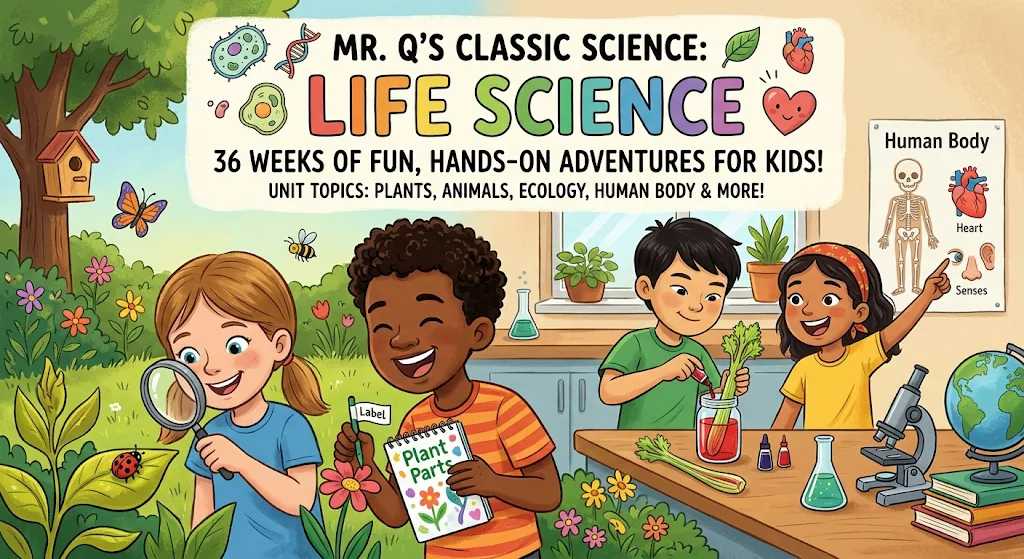
Mr. Q’s Classic Life Science Course is a complete, free 36 week life science curriculum for students in grades 3–6. Created by Scott McQuerry (affectionately known as “Mr. Q”), it is a secular, highly accessible program that swaps dry textbooks for humor, engaging comic elements, and hands-on discovery.
What Makes the Life Science Course Unique?
- Kid-Friendly Humor & Tone: The lessons use fun characters, jokes, and lighthearted comics to explain biology and ecology concepts without overwhelming young learners.
- Completely Free Access: The entire student textbook and parent resources are offered as free digital downloads on the website, making quality science education accessible to everyone. (The course may not always be free, so you may want to download it now for the future.)
- Flexible 3-Day Weekly Structure: Each week is cleanly divided into manageable chunks:
- Day 1: Reading assignments and worksheet reviews.
- Days 2 & 3: Hands-on experiments and inquiry-based activities to bring the lessons to life.
Core Curriculum Topics Covered
The 36-week program is broken down into 9 thematic, 4-week units that guide students from the basics of ecology all the way into human anatomy:
- Ecology & Environment: Living vs. non-living things, natural resources, recycling, habitats, and environmental niches.
- The Plant & Animal Kingdoms: Plant biology, ecosystems, food chains and webs, and major animal groups (from reptiles and birds to mammals and insects).
- The Microscopic World: Famine, disease, and viruses.
- Human Senses & Body Organs: Deep dives into vision, hearing, touch, taste, smell, and major organ systems including the skin, muscles, bones, heart, lungs, and digestive tract.
Hands-On & Inquiry-Based Learning
Instead of requiring expensive laboratory equipment, Mr. Q designed the activities in the life science course around common household items and inexpensive local store finds. The course incorporates the ESP (Exploring Scientific Procedures) Method, guiding kids through simple inquiry-based projects that help them think like real scientists. Whether used in a traditional classroom, a homeschool co-op, or for independent learning at home, Classic Science Life turns biology into an exciting adventure. For more free life science courses please see Life Science Course for 4th Grade and Life Science Course for Grade 5: Exploring Transport Systems in Animals and Plants.
Student Copy
Here is a linked list for the student version of the Life Science Course, organized by unit and chapter. You can download the full student copy here (19.5 MB).
Unit 1: Basic Needs/Resources
- Chapter 1: Living and Non-Living Things
- Chapter 2: Material and Non-Material Resources
- Chapter 3: Reduce, Reuse and Recycle
- Chapter 4: Habitats and Niche
Unit 2: Biomes
- Chapter 5: Grasslands and Forests
- Chapter 6: More Forest Biomes
- Chapter 7: Tundra and Desert
- Chapter 8: Aquatic Biome
Unit 3: Life Cycles
- Chapter 9: Species and Offspring
- Chapter 10: Plant Structure
- Chapter 11: Reptiles and Amphibians
- Chapter 12: Birds, Mammals and Insects
Unit 4: Classification
- Chapter 13: Classifying Animals
- Chapter 14: Classifying Plants
- Chapter 15: Classifying Fungi and Protists
- Chapter 16: The Bacterial Kingdoms
Unit 5: Food Webs
- Chapter 17: Food Chains
- Chapter 18: Food Webs
- Chapter 19: Famine, Disease and Viruses
- Chapter 20: Conservation Efforts
Unit 6: Senses
- Chapter 21: Taste and Smell
- Chapter 22: Vision, Hearing and Touch
- Chapter 23: “Other” Senses
- Chapter 24: The Brain
Unit 7: Body Organs
- Chapter 25: Skin, Muscle and Bone
- Chapter 26: Heart and Lungs
- Chapter 27: Stomach, Intestines and Kidneys
- Chapter 28: Pancreas, Liver and Gallbladder
Unit 8: Cells
- Chapter 29: Cells 101
- Chapter 30: Organelles Part I
- Chapter 31: Organelles Part II
- Chapter 32: Bacterial Cells
Unit 9: Health and Nutrition
- Chapter 33: Hygiene and Health
- Chapter 34: Immune System
- Chapter 35: Nutrition
- Chapter 36: Drugs and Your Body
Glossary
Parent or Teacher Copy
Here is a linked list for the parent version of the Life Science Course, organized by unit and chapter. You can download the full parent copy here (19.5 MB).
Unit 1: Basic Needs and Resources
- Chapter 1: Living and Non-Living Things — includes the parent introduction
- Chapter 2: Material and Non-Material Resources
- Chapter 3: Reduce, Reuse and Recycle
- Chapter 4: Habitats and Niche
Unit 2: Biomes
- Chapter 5: Grasslands and Forests
- Chapter 6: More Forest Biomes
- Chapter 7: Tundra and Desert
- Chapter 8: Aquatic Biome
Unit 3: Life Cycles
- Chapter 9: Species and Offspring
- Chapter 10: Plant Structure
- Chapter 11: Reptiles and Amphibians
- Chapter 12: Birds, Mammals and Insects
Unit 4: Classification
- Chapter 13: Classifying Animals
- Chapter 14: Classifying Plants
- Chapter 15: Classifying Fungi and Protists
- Chapter 16: The Bacterial Kingdoms
Unit 5: Food Webs
- Chapter 17: Food Chains
- Chapter 18: Food Webs
- Chapter 19: Famine, Disease and Viruses
- Chapter 20: Conservation Efforts
Unit 6: Senses
- Chapter 21: Taste and Smell
- Chapter 22: Vision, Hearing and Touch
- Chapter 23: “Other” Senses
- Chapter 24: The Brain
Unit 7: Body Organs
- Chapter 25: Skin, Muscle and Bone
- Chapter 26: Heart and Lungs
- Chapter 27: Stomach, Intestines and Kidneys
- Chapter 28: Pancreas, Liver and Gallbladder
Unit 8: Cells
- Chapter 29: Cells 101
- Chapter 30: Organelles Part I
- Chapter 31: Organelles Part II
- Chapter 32: Bacterial Cells
Unit 9: Health and Nutrition
- Chapter 33: Hygiene and Health
- Chapter 34: Immune System
- Chapter 35: Nutrition
- Chapter 36: Drugs and Your Body
Glossary
Here is a friendly, easy-to-read study plan and high-level lesson guide based on this Life Science curriculum.
The Weekly Rhythm: Keep It Simple
The curriculum is built around a flexible 3-day schedule per week, making it a breeze to fit into a homeschool routine, after-school learning, or weekend fun:
- Day 1: Read & Discover — Dive into the weekly reading assignment together. Mr. Q’s books are packed with fun illustrations and jokes, so reading feels more like reading a comic book than studying a textbook! Afterward, chat about what you learned and complete the review worksheet.
- Days 2 & 3: Hands-On Science Lab — This is the fun part! Use easy-to-find household items to test out experiments, observe nature, or build models that bring the weekly topic to life.
36-Week High-Level Lesson Plan
The course is broken down into 9 exciting units (4 weeks each), taking kids on a journey from planet Earth’s ecosystems all the way inside the human body.
Unit 1: Introduction to Ecology (Weeks 1–4)
- Week 1: What is Science? — Learn the scientific method and how to think like a real scientist.
- Week 2: Living vs. Non-Living — Discover what makes something alive and how living things interact with their environment.
- Week 3: Natural Resources & Conservation — Explore Earth’s resources and why taking care of our planet matters.
- Week 4: Habitats & Niches — Learn about homes in nature and the special “jobs” different animals have in their habitats.
Unit 2: The Wonderful World of Plants (Weeks 5–8)
- Week 5: Plant Parts & Basics — Roots, stems, leaves, and flowers—what do they all do?
- Week 6: Photosynthesis — Discover how plants make their own food using sunlight, water, and air.
- Week 7: Plant Reproduction — Seeds, pollen, and how new plants grow.
- Week 8: Plant Adaptations — How plants survive in tricky places like deserts or shady forests.
Unit 3: Ecosystems & Food Chains (Weeks 9–12)
- Week 9: Food Chains — Who eats whom? Trace energy from the sun to plants and animals.
- Week 10: Food Webs & Pyramids — Explore complex community connections in nature.
- Week 11: Symbiosis — Partnerships in nature where animals and plants help each other out.
- Week 12: Biomes of the World — Take a tour of rainforests, tundras, deserts, and grasslands.
Unit 4: The Animal Kingdom (Weeks 13–16)
- Week 13: Invertebrates — Meet the animals without backbones, from bugs to jellyfish.
- Week 14: Cold-Blooded Vertebrates — Dive into fish, amphibians, and reptiles.
- Week 15: Warm-Blooded Vertebrates — Explore birds and their amazing adaptations for flight.
- Week 16: Mammals — Learn about furry creatures, from tiny mice to giant whales.
Unit 5: The Microscopic World (Weeks 17–20)
- Week 17: Cells – The Building Blocks — Peek into the microscopic world that makes up all living things.
- Week 18: Bacteria & Microbes — The good, the bad, and the tiny germs all around us.
- Week 19: Fungi — Mushrooms, molds, and how recyclers of nature work.
- Week 20: Viruses & Health — How our bodies fight off microscopic invaders.
Unit 6: The Human Senses (Weeks 21–24)
- Week 21: Sight & Eyes — How your eyes capture light and help you see the world.
- Week 22: Hearing & Ears — Sound waves, vibrations, and how we hear music and voices.
- Week 23: Taste & Smell — The dynamic duo of flavor and scent.
- Week 24: Touch & Skin — Your body’s largest organ and how it keeps you safe.
Unit 7: Bones, Muscles, and Movement (Weeks 25–28)
- Week 25: The Skeletal System — Your body’s framework and why bones are super strong.
- Week 26: Joints & Cartilage — How your body bends, twists, and moves.
- Week 27: The Muscular System — Muscles at work: voluntary vs. involuntary movement.
- Week 28: Keeping Fit — Exercise, stretching, and keeping your body strong.
Unit 8: Powering the Body: Heart & Lungs (Weeks 29–32)
- Week 29: The Respiratory System — Breathing in oxygen and blowing out carbon dioxide.
- Week 30: The Circulatory System — Your heart as a tireless pump moving blood everywhere.
- Week 31: Blood & Immunity — Red cells, white cells, and how your body heals.
- Week 32: Healthy Habits — Nutrition, sleep, and keeping your heart and lungs happy.
Unit 9: Digestion & Body Management (Weeks 33–36)
- Week 33: The Digestive Track (Part 1) — From the first bite to the stomach.
- Week 34: The Digestive Track (Part 2) — Intestines, nutrients, and turning food into energy.
- Week 35: The Nervous System — The brain and spinal cord: mission control for your body!
- Week 36: Grand Finale Review — Celebrate a year of incredible science discoveries with a fun wrap-up project or quiz!
-love learning -your best ed lessons guide, Scott











1 Comment